London Review of Books Do Anyone Have Right to Sex
On the Shelf
The Right to Sex activity
By Amia Srinivasan
FSG: 304 pages, $28
If you purchase books linked on our site, The Times may earn a committee from Bookshop.org, whose fees support independent bookstores.
"The Right to Sex," a drove of essays by Amia Srinivasan, feels a bit like old news. This is not a knock on Srinivasan, a professor of social and political theory at Oxford University, merely rather a reflection on how rapidly the discourse on feminism and trans rights has evolved since the writer published the essay that anchors the volume — "Does Anyone Take a Right to Sex?" — in the London Review of Books back in 2018.
Srinivasan pulled her title phrase from the aftermath of Elliot Rodger'south 2014 murderous binge, after which fellow incels promoted a "misogynistic entitlement" to sex. Since then, the "right to sex" has morphed from a literal definition (through the issues of consent and the #MeToo movement) toward a philosophy of liberty.
A succinct and articulate writer, Srinivasan defines her terms in helpful and revealing ways. For instance, "incel," or "'involuntary celibate,' was coined by Alana, a 'nerdy queer woman'" and blogger, in the 1990s. Not every reader may exist familiar with the idea of "carceral feminism," and Srinivasan explains it well: "a politics that looks to the coercive power of the state — police, criminal courts, prisons — to accomplish gender justice."
Another key concept for Srinivasan is intersectional Marxist feminism. She is at her strongest when demystifying it as a framework that attacks the system rather than "men" as a grouping. Her most provocative arguments stem from the notion that sexual politics cannot exist fully examined without speaking truth on race and form. When we talk about the need to #believewomen, "Whom are nosotros to believe," Srinivasan asks, "the white adult female who says she was raped, or the black or brown adult female who insists her son is existence ready?" To use the murder of Emmett Till every bit an example: "Carolyn Bryant or Mamie Till?"
The author complicates #MeToo'southward castigating impulse past noting that "a black human being serving time for sexual attack is iii.5 times more likely to exist innocent than a white man" with the same confidence. And those white men (she takes comedian Louis C.Grand. as an example) "do non deny the truth of the allegations against them, nor even the harm they caused. What they deny is that they deserve to be punished." That question, for Srinivasan, is straight related to race and grade; information technology is "virtually the possibility that the police might care for wealthy white men as information technology routinely treats poor blackness and chocolate-brown men."
Things become murkier when Srinivasan veers into the politics of desire. In the chapter "Talking to My Students About Porn," she writes, "sex for my students is what porn says it is" — a rather alarming statement. Porn is everywhere, but the statement that information technology has poisoned an entire generation, making it impossible for them to recollect about sexual practice for themselves, feels besides broad and poorly supported. Feminism's attacks on porn in the '70s and '80s (via Robin Morgan, Andrea Dworkin and others) looks joyless now. Even the concept of "sexual activity positivity" seems dated.
Some of Srinivasan's assertions about pornography are rattlingly obtuse: "Women watch porn also; co-ordinate to PornHub, 32 percent of all its users are women. (Then once more, who said women tin't be misogynists?)"; "While filmed sexual activity opens up a world of sexual possibility, all also oftentimes information technology shuts down the sexual imagination, making it weak, dependent, lazy, codified." Says who?
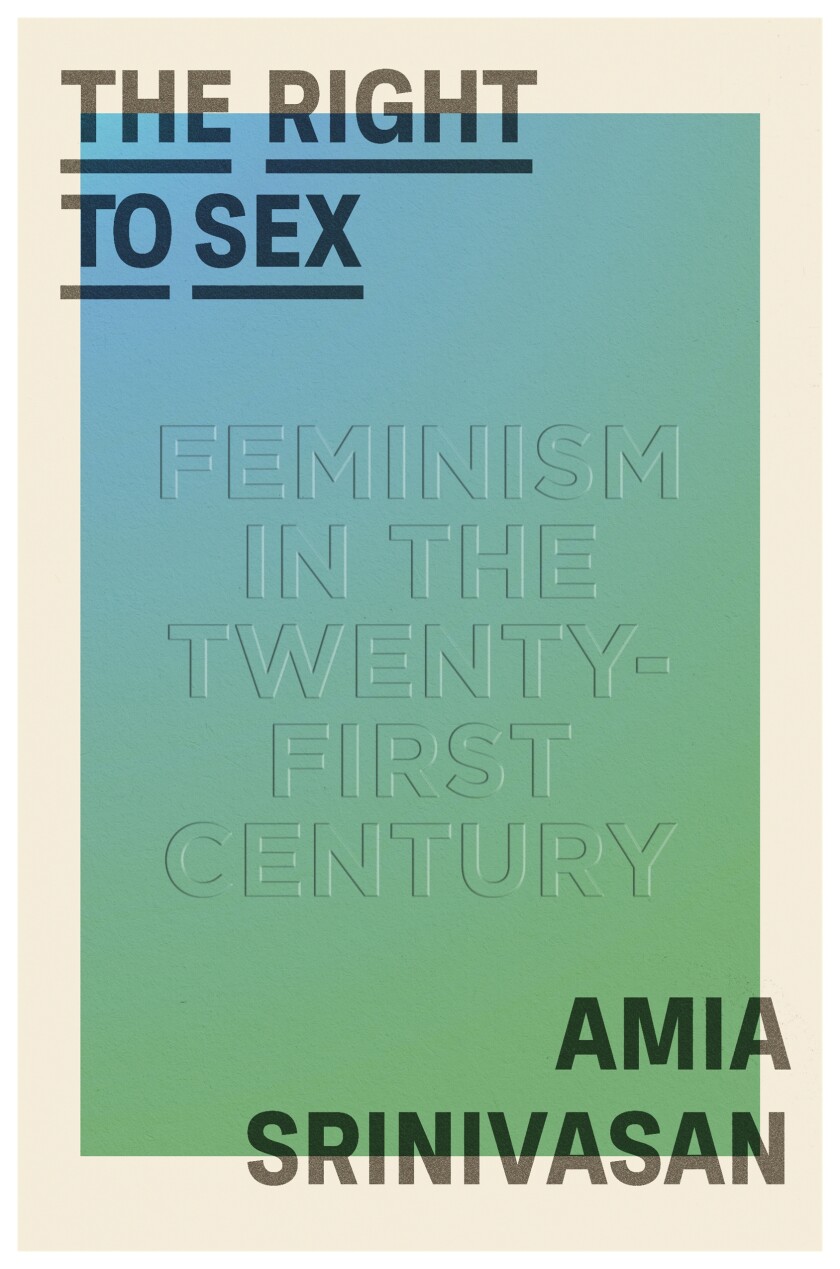
(Farrar, Straus & Giroux)
Only every bit I was about to write that Srinivasan relies also heavily on heteronormative ideas, her essay, "The Sexual practice Wars: Resolving Feminism's Trans Disharmonize," appeared in the Sept. xiii issue of the New Yorker, answering many of my questions about her reliance on the gender binary. All the stiff writing Srinivasan displays in "The Right to Sex" is applied to a more current and heated argue in this slice.
"Such feminists tend to be dismissive of not-binary people," Srinivasan writes of TERFs (trans-exclusionary radical feminists), "who, in their refusal of gender distinction, have a good claim to being the truest vanguard of gender abolition." This inclusion of trans and nonbinary people in a discussion of feminism is what you'd expect of a book that claims to hash out feminism "in the twenty-first century." Many of the points she makes in "The Right to Sexual activity" as well appear in this essay — and are put to better use.
In the volume'southward terminal chapter, Srinivasan returns to her potent adapt, the limitations of white feminism, while addressing sex work. "The belief that a sex worker will be helped past the criminalization of her trade rests on the assumption that she has other choices available to her," she writes. "That it is prostitution, rather than, say, poverty or immigration law, that is her fundamental problem." Feminism fails the majority of women in the globe considering information technology is based on the demands of the privileged. While #MeToo is a skillful start, "for many women," Srinivasan points out to devastating effect, "existence sexually harassed is non the worst affair well-nigh their jobs."
The #MeToo juggernaut will continue to reflect in 21st century feminism. But the emergence of a writer like Srinivasan, who asks feminists to go further, is an enormous gift to the soapbox. Her New Yorker essay expands on the evidence she presents in "The Right to Sex" in which feminists delay or complicate progress by their own infighting. Audre Lorde, in "The Cancer Journals," wrote of feminism'due south tendency to bicker over whose experience was the nearly of import or essential to the goals of the group. Such arguments were symptomatic, Lorde writes, of the "endless ways in which we rob ourselves of each other."
It'due south obvious that Srinivasan is a thinker whose ideas tin can evolve, as they must. Hither she is, again in the New Yorker, on the potential brotherhood between feminists and trans people: "Information technology is true that a very small pct of human beings feel sufficient distress about their bodies to need hormonal or surgical intervention. Information technology is likewise true that many non-trans women know something of the heartbreak caused by a body that betrays — that weighs you down with unwanted breasts and hips; that transforms you from an amanuensis of action into an object of male desire; that is, in some mortifying sense, not a reflection of who you really are . . . . What might a chat between women, trans and non, look like if it started from a recognition of such continuities of feel?"
While the struggle to define "the right to sex activity" rages on, one thing is for certain: Amia Srinivasan has entered the chat.
Ferri's most recent book is "Silent Cities: New York."
faulknerwittentiou.blogspot.com
Source: https://www.latimes.com/entertainment-arts/books/story/2021-09-21/is-a-new-book-feminisms-next-new-wave-or-yesterdays-backlash
0 Response to "London Review of Books Do Anyone Have Right to Sex"
Postar um comentário